
Team Elevar

Parents in Mangaon and Kurduwadi have waited years for their children to speak English with confidence. These are semi-rural towns in Maharashtra with fewer than 30,000 people each. Most children there can read and understand English, but few speak it. We first mentioned these schools in 2020, when LEAD used its experience there to keep children learning at home during the lockdown. LEAD schools in both towns have now shown parents Fluento, LEAD’s AI programme for spoken English, and many said it was the solution they had been waiting for. Pilots LEAD ran separately across 10 schools in Mumbai, Bengaluru and Delhi, with about 1,000 students, showed around 2x improvement in conversational ability between structured pre- and post-assessments.
To understand the significance of this, it helps to take a step back. Sumeet and Smita started a school of their own in 2012, before they built LEAD, so they could see first-hand where children fell behind. Everything LEAD has built since starts from what a child in a small-town school needs to learn. Today it partners with around 9000 Affordable Private Schools, nine in ten of them outside the metros. Most of the families are Entrepreneurial Households (EHs) who choose an English-medium private school for better learning. They are discerning about what that fee buys.
Elevar has been an investor in LEAD since its Series A. In 2023, a member of our team visited LEAD schools in Rajasthan and Tamil Nadu to see the work on the ground. She did not say she was from Elevar, so that school owners would speak freely.
Ultimately, the visit showed that LEAD’s approach worked best in schools that could put all of it into practice. Two things often stood in the way:
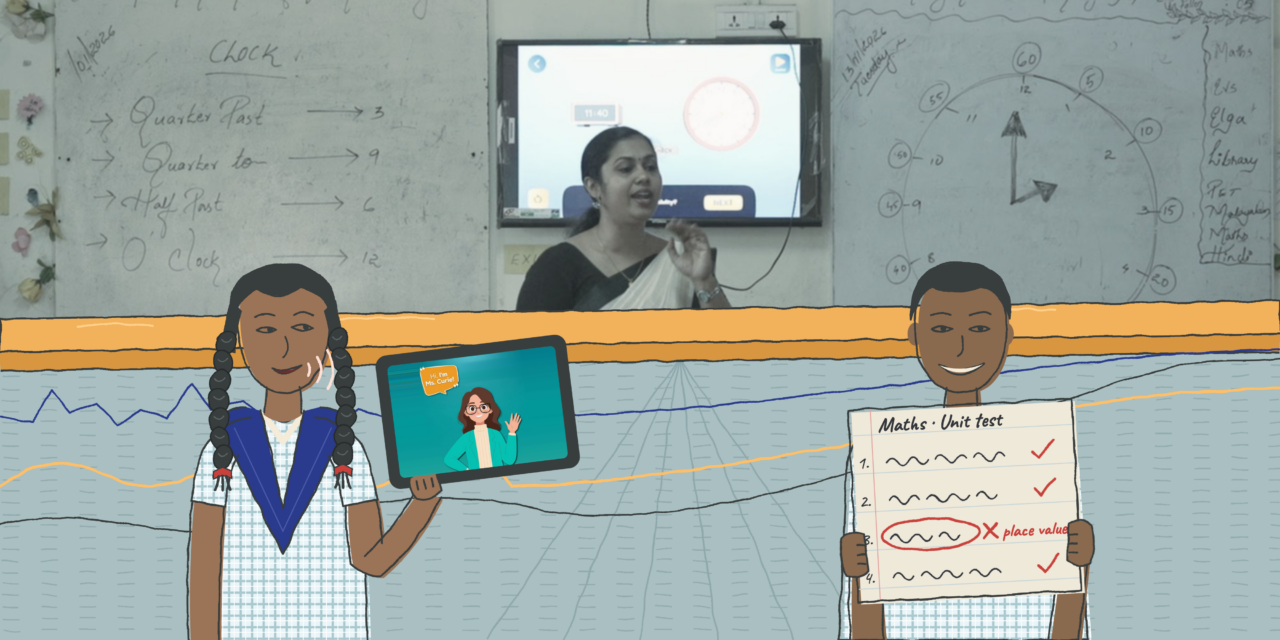
LEAD’s AI business for schools addresses both through two products, Ms. Curie’s Fluento and GradePlus. For context, Ms Curie is an AI Tutor that works alongside teachers in classrooms to provide students with individual support and practice.
Ms. Curie’s Fluento is the response to the capacity constraint. It is a spoken English course: the workbooks, the lesson structure, and the practice the child does with Ms Curie during the school day. It builds on ELGA, the programme schools valued most in 2023, and is adapted to give children patient practice with the language skills that the teacher introduces in class. Basically, it takes English from reading and writing to speaking.
Ms Curie’s Fluento is built for students from Class 1 to Class 8, and Ms Curie holds a spoken conversation with each child at that child’s level. Ms Curie has also been built to recognise Indian accents, which vary as much as the schools do. One-on-one tutoring has long been the most effective way to teach a child, and it has always been too expensive for most EHs. Ms Curie brings one-on-one practice within the cost of a school fee. Parents pay schools Rs 200 per month for Ms. Curie’s Fluento!
GradePlus is the response to the visibility constraint, and to the question parents raised about showing progress. It works on the answers students write in exams. A teacher uploads the scripts, and GradePlus grades each answer and identifies the concept behind every lost mark. LEAD’s aim is for every student to receive that feedback on the day of the exam, with no extra work for the teacher.
That changes what a lost mark means. A rote system gives a student a lower total, and she often repeats the same incorrect method in the next exam. A lost mark on a GradePlus paper points to the concept she has not yet understood, while the exam is still fresh in her mind. Each mistake becomes a teaching moment. The school builds a concept-by-concept picture of each child’s progress over the term, and that picture tells a parent far more than just grades.
Therefore, GradePlus augments the student; Ms. Curie’s Fluento augments the teacher; LEAD augments the school; the school augments the household’s aspirations. AI in this case also takes on the quality of a reliable business trajectory instead of a “new fad” by serving a clear and existing need all the while integrating into a space that stays fundamentally human.
These are early steps. We, for one, are very excited to see where this leads, and what kind of outcomes it unlocks on the ground.